Functional Parts That Survive the Real World
End-use components printed in engineering-grade materials, inspected against your tolerance sheet, and shipped with a dimensional report. Not prototypes — parts that go into the product.
What Each Material Can Actually Do
Mechanical properties at a glance. Numbers below are typical values from our internal test bench, not marketing claims from a resin distributor.
Need a specific value? Request the full technical datasheet for any material with measured stress-strain curves, HDT, and creep data.
Holding Tight on the Features That Matter
Not every dimension needs ±0.1 mm. We classify your features into three tiers and hold the right tolerance on each one, so you pay for accuracy where it counts and skip it where it does not.
See Our QC ProcessBearing bores, sealing surfaces, mating faces, and any feature that defines fit or function.
Most external dimensions, mounting holes, and features that touch other parts without a load path.
Cosmetic surfaces, non-functional contours, and internal features that never interface with anything.
Parts Currently Running Through Our Shop
Real components from real customers, running right now on production equipment or in field use.
Enclosure brackets
PC-ABS brackets for a rack-mount device. 500 units per month, 18-month field failure rate of 0.2%.
Device housings
Nylon PA12 housings for a handheld diagnostic tool. Biocompatible post-processing, cleanroom bagging.
Under-hood clips
PA12-CF cable clips rated to 120 °C. Replaced a metal part that corroded in field service.
End-effector jaws
TPU 95A soft jaws for a pick-and-place line. 200k+ cycles without cracking or losing grip force.
We Test Before You Install
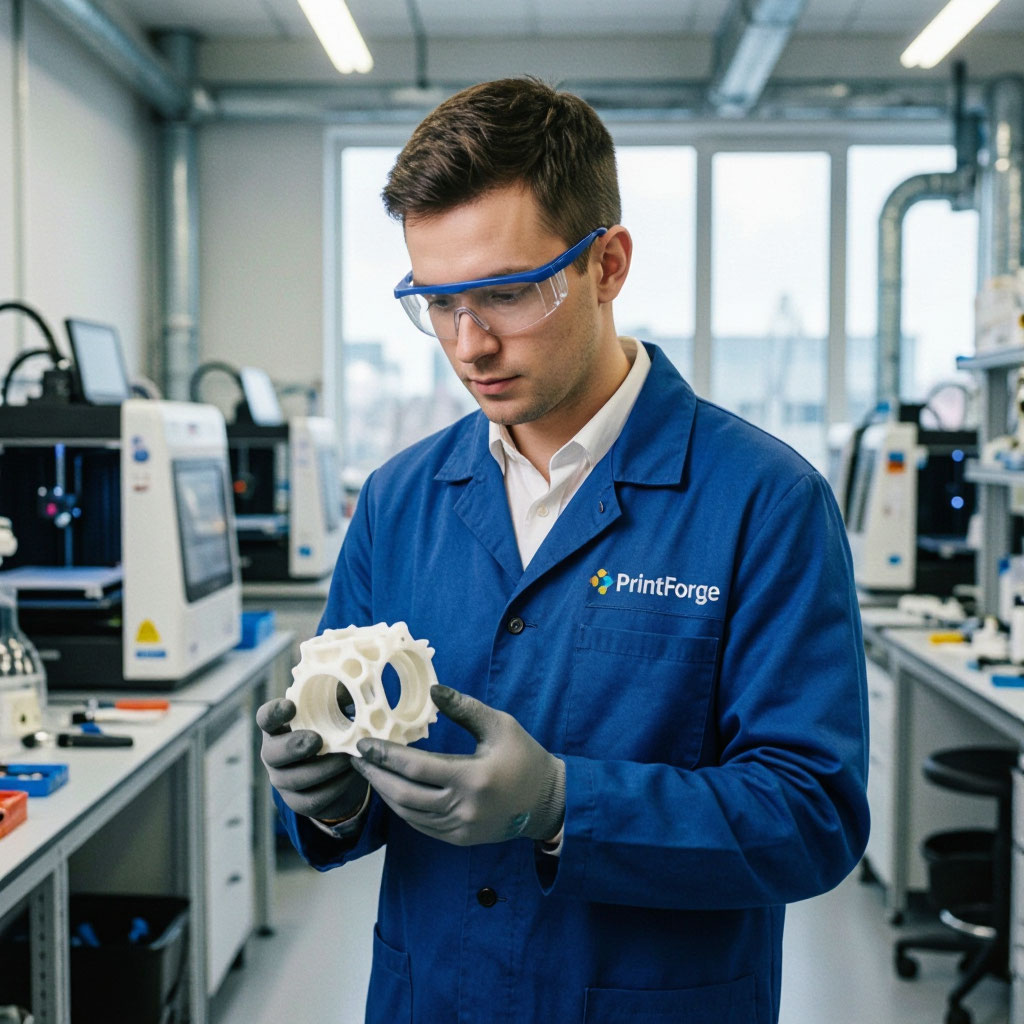
For load-bearing or safety-relevant parts, we run the piece through our own test bench before it ever leaves the shop. You get the test report with the shipment.
Dimensional inspection
Full CMM report against your drawing with measured points at nominal, minimum, and maximum material condition.
Load and fatigue
Instron tensile tester up to 5 kN. Cyclic loading up to 500k cycles on request, with graphed results.
Thermal cycling
Environmental chamber from -40 °C to +150 °C, four-hour cycles, up to 100 cycles for automotive parts.
Chemical exposure
Soak testing in customer-specified fluids to verify the material survives contact with oils, solvents, or cleaners.
Which Process Should Print Your Part?
Three processes, three different answers. Here is how we decide, and how you should too.
FDM
Strong, affordable, visible layersChoose FDM when the part is large, structural, or has a defined load path along the layer direction.
- Largest build volume in the shop
- Best cost per gram of material
- Wide range of engineering plastics
- Layer lines may need post-processing
SLA
Fine detail, smooth surfacesChoose SLA when surface finish matters and the part has small features under a millimeter.
- Layer heights down to 25 microns
- Watertight, smooth finish straight off the printer
- Rigid, dimensionally accurate
- Smaller build volume than FDM
SLS
Isotropic strength, no supportsChoose SLS when the part has to be strong in every direction and cannot have support marks.
- No supports, no directional weakness
- Living hinges and snap fits straight off the bed
- Complex internal geometry possible
- Higher cost per part than FDM
Functional Parts FAQ
We ask three questions: what loads does the part see, what environment does it operate in, and how many units do you need. From there we map to two or three materials and price each one so you can compare cost against capability directly.
Yes. Send us a physical sample or a Pantone code and we will match it in the closest base material, then overcoat with automotive-grade paint if a precise match is critical. Color match adds one to two days to the lead time.
Yes, on every order. The CoC lists material lot numbers, print parameters, inspection results, and the technician who signed off. It is emailed as a PDF and a printed copy ships in the box.
One part. We run single-piece functional parts for maintenance and repair work all the time. Volume pricing kicks in at 50 units, but there is no minimum to place an order.
We can print in food-contact-rated PETG and post-process it to a smooth, non-porous finish. Full FDA compliance testing is not something we do in-house, so please validate against your own regulatory requirements. Read the details in our Terms of Service.
Send us the failed part and we will inspect it at no charge. If the failure traces back to a print defect or a material issue on our side, we reprint the full order at our cost. If it traces back to an unexpected load case, we will help you redesign the part for the next run.
Have a drawing and a deadline?
Send the part file, the tolerance sheet, and the quantity. You will have a quote and a material recommendation within two business hours.
Send the Drawing. We’ll Send the Part.
Quotes within two hours, functional parts on your dock within a week.